For quite some time I have been writing a book on the craft of cost estimating for historic restoration work. It seems like as good a thing as any to do when there is not enough work to keep me away from writing. Some of you may have unknowingly already read portions of the book. This particular chapter I had to fight with quite a bit before I got it to lay down. You can read and hear me reading it in audio while you read it here:
007 Metabolic Rates, Speed and Consumption
The material is no longer available online.
Tuesday, May 4, 2010


Saturday, May 1, 2010

Brick Chicken

I am training my chickens to lay on a brick.
You never know where the future craftschickens will be coming from!
Cherry Blossom Drift & Petal Wine
Earlier this week at the Ronkonkoma train station on Long Island I noticed that the cherry blossoms on the sidewalk had blown around and formed drifts. A concentration of petals like this could be a bonus for anyone wanting to experiment with making cherry blossom wine.
 Dandelion wine is made with the yellow-white petals of the mature flower. One of the tasks in making dandelion wine is to pull all of the petals free of the bitter green parts. One difficulty is that though dandelions do grow like weeds the places where they most abundantly grow, and are most easily gathered are on public lawns... like at the local park. Then the question is if they are clean of herbicides, goose shit, and fertilizer or not. Dandelions gathered from near to highways, or in city environments may also contain traces of lead which is a toss up if the alcohol or lead will dumb you down first.
I use a champagne yeast when I make dandelion wine as it kicks up the alcohol content to the max for a wine. Percentage of alcohol in a natural wine is determined by when the concentration of alcohol is enough to kill the yeast that has produced the alcohol. A champagne yeast can handle alcohol better than most yeasts. I do not post-ferment in the bottles, so the bottles are not the exploding kind that you would knock the tops off with a sword. As an aside, when I proudly gave a mason jar of it to my Canadian Scot stonemason friend he immediately asked if I was handing him a jar of my best pee.
My home-brand is labeled Hobos Last Choice.
 I have been collecting and drying rose petals for several years now with an idea that someday I will make rose petal wine. We only own one rose bush and so it is taking me a long time to collect enough petals to take the project to a next stage of development. We will accept contributions.
Wine making with non-grape materials is something that I have been involved with off and on since a very early age and one of my earliest memories is the excitement around my stepfather's rootbeer bottles when they exploded at night in the kitchen. Though it was not wine that he was making the mess did spray sticky syrup over everything. In my child's imagination I always wondered if that was why we eventually moved to another house. I also, as a young adult first out on my own remember accidentally dumping 5-gallons of elderberry mash in a kitchen of a group house where I was squatting in the swallow barn. The paying tenants were not very happy about that. I was not happy for losing all the elderberries that I had collected. (Note: Avoid confusing elderberries with water hemlock.)
Though wine is most often made with grapes, and vineyards and wineries are certainly an industry on Long Island (and where I come from is not far from the wine country of Hammandsport, NY), I enjoy making wine with unusual materials like elderberries, cantelope, grapefruit and plums. If I want wine made with grapes I can go buy it at the store.

I use a champagne yeast when I make dandelion wine as it kicks up the alcohol content to the max for a wine. Percentage of alcohol in a natural wine is determined by when the concentration of alcohol is enough to kill the yeast that has produced the alcohol. A champagne yeast can handle alcohol better than most yeasts. I do not post-ferment in the bottles, so the bottles are not the exploding kind that you would knock the tops off with a sword. As an aside, when I proudly gave a mason jar of it to my Canadian Scot stonemason friend he immediately asked if I was handing him a jar of my best pee.
My home-brand is labeled Hobos Last Choice.
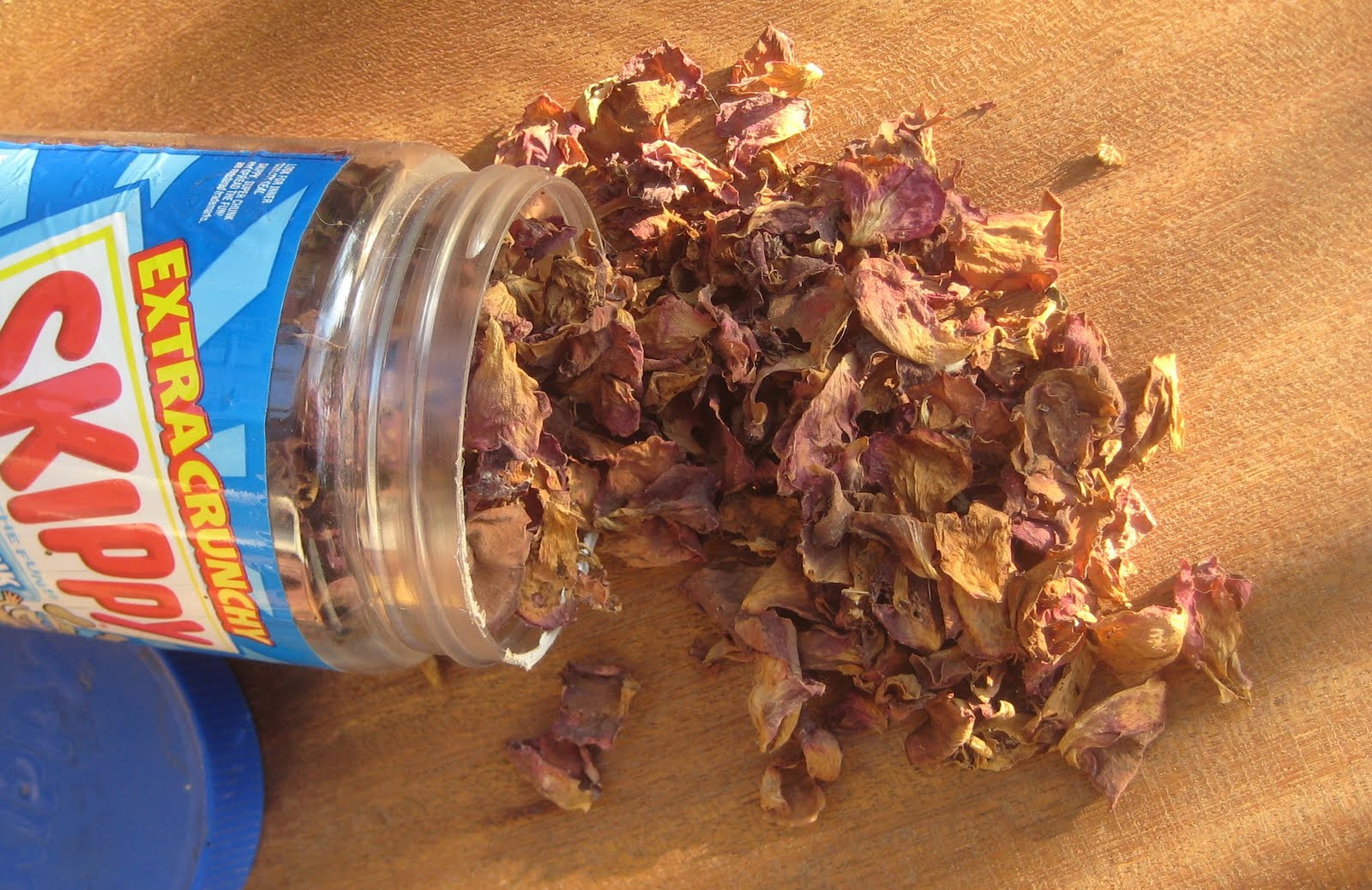 I have been collecting and drying rose petals for several years now with an idea that someday I will make rose petal wine. We only own one rose bush and so it is taking me a long time to collect enough petals to take the project to a next stage of development. We will accept contributions.
Wine making with non-grape materials is something that I have been involved with off and on since a very early age and one of my earliest memories is the excitement around my stepfather's rootbeer bottles when they exploded at night in the kitchen. Though it was not wine that he was making the mess did spray sticky syrup over everything. In my child's imagination I always wondered if that was why we eventually moved to another house. I also, as a young adult first out on my own remember accidentally dumping 5-gallons of elderberry mash in a kitchen of a group house where I was squatting in the swallow barn. The paying tenants were not very happy about that. I was not happy for losing all the elderberries that I had collected. (Note: Avoid confusing elderberries with water hemlock.)
Though wine is most often made with grapes, and vineyards and wineries are certainly an industry on Long Island (and where I come from is not far from the wine country of Hammandsport, NY), I enjoy making wine with unusual materials like elderberries, cantelope, grapefruit and plums. If I want wine made with grapes I can go buy it at the store.
Saturday, April 24, 2010
Saturday Afternoon Wanderings on Long Island

Another salesperson, I think they were selling life insurance, stopped me and said, “I always wanted to go to Plum Island.” I replied, well, it is not exactly a tourist destination. They asked me what it is like. I said that they may force you to strip naked and take a shower before you leave the island. He seemed to like that idea as I ran off to learn the latest in hot tub technology.
He said, "You don't need to apologize to me. I have some extras if you want one?" Then the fellow selling home mortgages asked me if I wanted one I said, "I already paid off the one I had." "He said, "Do you want another one?"
Another young fellow explained to me that for free he would stick a fan in my door and suck air out of the house then tell me how much it would cost for him to save me money. I wanted to know his secret but he got mad when I refused to sign his pledge. The last time I joined a religion it nearly killed me.
Then I went to Suffolk Community College to the Ecology Fair and the ladies at the Lyme disease tick control table across from the all-natural purple stuff table, asked me if I work at Plum Island. “No,” I said, “I was on vacation.” I was worried they may blame their fervid health-scare cause on my nocturnal indiscretions. Which reminds me that this morning I was reading about how Brookhaven Labs, just north of where we live, shot down a UFO with a quark gluon plasma beam weapon. The craft from wherever in the universe those things come from it crashed and burned in our local park and they built a horse stable there to hide the evidence. Which reminds me I need to go over there and get some manure for the garden.

I went to Port Jefferson thinking to visit the Antique & Garden show... but decided I was not into macramé and glass all that much and walked around and found a 12 person bobsled at Bayles Boat Shop where on Saturday and Wednesday mornings I can go volunteer to learn to build wooden boats. The Timber Framers Guild helped to build the Bayles Boat Shop.

Headed home, still w/ the Plum Island t-shirt on, I stopped at a bait & tackle shop and asked the proprietor if he sold earthworms. He said, “Yes.” I asked, “How big are they?” “They are trout worms,” he said, “they are small ones.” I said, “Are they like red wigglers? I don’t know what a trout worm looks like.” “You never seen a trout worm?” he said, “They are smaller than large earthworms.” “Can I see some?” “What you wanna use them for?” “I want to feed my chickens.” “Pretty expensive chicken food!” “I'm teaching them to eat out of my hand. I want them to get used to me. They really like worms.” “Do you eat them?” He almost caught me with that trick question and I almost fessed up. “No, you don’t eat circus chickens.”

Histo Presto: Aluminum Siding
Note: the following is an excerpt in draft from the book on estimation of histo presto that I have been working on. Inclusion here results from my friend Christopher Gray having posted an e-mail to BP [My next book: "How Aluminum Siding Saved Civilization."] re: an e-mail to him in which tfb17 shared his selection of photos that were inspired by Christopher's column on Vanderbilt Ave. in Brooklyn. "Two more gable-end houses of Gothic styling survive at 92 and 94 Vanderbilt. No. 92’s decay ventures beyond the charming into the alarming, with its falling-off siding and collapsing front stoop. Photographs from the 1940s indicate that it, too, had intricate verge-board trim, and show a delicate Gothic-style window at the top. It is a pity they are gone. At the same time, the asbestos-like shingle siding, perhaps from the 1940s, is a tour de force, vertical stripes in maroon, gray and other colors, like a weird 1950s blazer. It would be a tragedy to lose that, too." The photos take me home a bit as we lived in this very same community of aluminum siding for nearly eight years and our business offices were located in the heart of the Greenpoint community for close to 20 years.
"When I first became aware of this notion of metabolic rate connected with geographic location was on a visit from Brooklyn to a meeting in Washington DC at the National Trust offices where I was asked, as an aside and not directly relevant to the topic of the meeting, “What do you think of aluminum siding?”
At that time we lived in Greenpoint-Williamsburg, Brooklyn in an Italian neighborhood where the aluminum siding salesmen had in the 60s and 70s gone bonkers and covered over all of the gingerbread and Victorian 19th c board-work of the three and four story building stock. What I saw around me was an aging aluminum siding that presented not only aluminum, but color selected by property owners with an expression of their own cultural aesthetic, and a community that had obviously bought into the expressed merits of aluminum siding. As a built environment in itself I found the exploration and detailing of what can be done with aluminum siding to be quite interesting. So, my initial reaction to the question was that I like aluminum siding.
Though I knew that there was something wrong with my answer I had not put the aluminum siding there on the facades, so I did not feel culpable for the existence of it, and I was curious and remain curious what will be decided in future to maintain or restore it. When the aluminum siding falls off there is often an asphalt faux brick/stone sheeting, and when that falls off there is wood clapboard siding, where it has not rotted. Occasionally a house can be found where aluminum siding was never applied and the original fabric of the wood clad structure is intact (most often unpainted), and quite often the original carpentry work is elegant in simple details. To make repairs to aluminum siding when it fails can present as many conundrums as needed to restore historic brickwork, just that nobody on the larger histo presto radar particularly cares about aluminum siding. And I agree that there are a whole lot of envelope and moisture related problems with aluminum siding, as well as with vinyl and that neither material is the zero-maintenance solution that many homeowners may have bought into.
The person who asked me was the executive director of an historic trades training program for the National Park Service, an architect by profession, and it was quickly apparent to me that they did not like aluminum siding.
I note that, and based on my subsequent years of experience, that the National Park Service is not likely to initiate a program for restoration of aluminum siding, any more than they are going to be interested in restoration of historic house trailers, even if they have a few in their remote desert portfolio, but that if there is going to be a revival or development of the trade skills needed to restore and conserve aluminum siding it is likely to be driven by the local fix-it-upper folks in the urban communities of the likes of Brooklyn where aluminum siding is prevalent and concentrated. Skill sets develop and are maintained based on an employed need. We have only to look to the development of the Brownstone revival industry, where stone facades are often scraped back and replaced with a faux brownstone stucco, and colored-stucco is the trade practice that is learned, to wonder what the future preservation movement will look like around aluminum siding."
Sunday, April 18, 2010
Multiculturalism: Western vs. Islamic Science
I put this here as a future footnote to an as yet unwritten rant that I have been mulling over in my spare brain cells. The rant has to do with non-dualism of mind-body, craftsmanship, fine brickwork, creative writing, flash fiction on the internet, creative boundaries between fiction and non-fiction, Green sustainable human built-environments, geographically determined metabolic rates of learning in heritage conservation, the Sokal Hoax and the Cardiff Giant (of which I understand my family ancestry has a connection).
Berman's article is 28,000 words, really long, and this Sunday morning I have carefully read through all of it to the end. This following paragraph is the only one with a direct connection to my rant, all other implications of comparison are indirect though no less valid if they can at all be drawn out.
Paul Berman, The New Republic, June 4, 2007
Berman's article is 28,000 words, really long, and this Sunday morning I have carefully read through all of it to the end. This following paragraph is the only one with a direct connection to my rant, all other implications of comparison are indirect though no less valid if they can at all be drawn out.
“Then again, if [Tariq] Ramadan means to suggest, by pointing to Islamic thinkers of the Middle Ages, that ancient roots are everything; or that science and rationality come in different versions depending on one’s origins, a version for Muslims and a different version for everyone else; or that universalism itself comes in different versions, and my universalism may not be the same as yours, and truth varies from culture to culture—then, of course, further questions arise. The notion that science and rationality come in different versions is an old idea: it is the notion that, taken to a logical conclusion, led the Nazis to suppose that physics came in an Aryan version and in a Jewish version, which were not identical, even if Jewish physics and Aryan physics appeared to be identical; and led the Stalinists to suppose that proletarian science was one thing and bourgeois science another, in spite of every superficial resemblance; and so on. This kind of argument is not hard to stumble across in Islamist literature: the notion that science comes in a Western version and also in an Islamic version, which are not the same. The same idea re-appears today in a sweet-tempered postmodern variation, as a kind of multiculturalism taken to the nth degree, in which every culture is pictured as equivalent and unique, and each culture’s claims to universal principles ought to be taken with a grain of salt, as an agreeable rhetoric that probably does not mean very much.”
Paul Berman, The New Republic, June 4, 2007
Subscribe to:
Posts (Atom)


