Thursday, December 24, 2009

vid: Santa Ran a Backhoe

poetry by Larry C. Simpson, author of The Lost Cave of the Jaguar Prophets.

Larry: "I don't usually write country songs or Christmas songs or otherwise schmaltzey stuff, but I kept hearing the voice of Kris Kristofferson past in my head."


Santa Ran a Backhoe

Santa ran a backhoe
and sometimes chewed tobacco
until he got too sick and lost his job.

The whiskey took away the pain
but sometimes made him go insane
and the neighbors sometimes had to call a cop.

Santa had a pickup truck
He remembers how he once got stuck
while hunting deer up on the rocky creek.

When his father tracked him down
and saw the bottles on the ground,
he got so mad he couldn’t even speak

Now his own son’s in rehab
and his daughter’s in Iraq
but they both tried to be just like their Pa.

He has three grandchildren
but he never gets to see them
since his ex-wife took them back to Arkansas.

Santa lost some friends he’d known
in the bloody combat zone
and left some of his soul in Viet Nam.

Santa had his house foreclosed
and walks through town just like a ghost
wondering why the banks don’t give a damn.

He’s king of the shopping mall
with elves and snow and lights and all,
a white beard and a bright red uniform.

But he once dug the footers
for the banks and stores and Hooters
And before that it was all just fields of corn.

He wonders what it was worth,
all the hardship, time and hurt.
Then a little girl climbs up into his lap.

First he says his Ho-Ho-Hos
then asks what she wants the most
And all she says is bring me back my Dad.

He’s gone to this funny land
that no one seems to understand
where people hurt each other just for spite.

Santa said, I’ll do my best.
Little girl you must be blessed.
You’re the angel that saved my life tonight.


copyright 2009 Larry C. Simpson

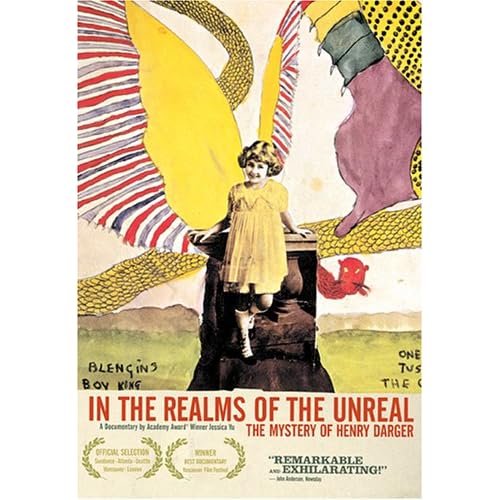
Henry Darger

I have assembled the following list of links for my own reference and that of readers of this blog. I thank Cami Park for having brought the work of Henry Darger to my attention.

Wikipedia: Henry Darger


Documentary film on YouTube: In the Realms of the Unreal (Henry Darger)

Part 1
Part 2
Part 3
Part 4
Part 5
Part 6
Part 7
Part 8
Part 9
Part 10
Part 11
Part 12

Jessica Yu, producer of In the Realms of the Unreal, video interview
IMDb

Charles Krafft


Villa Delirium Delft Works

Wednesday, December 23, 2009

vid: Home Pharmacy by Ellen Parker

For me the most important thread of this story is when I think of my friends who have had to either deal directly with the side effects of chemo therapy, or who have had to attend to their closest loved ones in same. I thank my friend Ellen Parker for having provided such a wonderful text for me to play with.


Home Pharmacy by Ellen Parker

She has found that taking these drugs improves her mood, but negatively impacts her vision.

You didn't use "impacts" as a verb, did you? And you didn't modify it with "negatively," did you?

Me? No. It was her. She.

That ugly nasty disgusting dumbfacedirtysexy annoying loser smelly fastbitch.

She's not that ugly. She's not that fast.

She has found that drinking coffee might shoot a panic attack. Annoying janes in the shoulder. Racing joints. Quivering buds.

That's no panic attack. That's drunk chronic ganja hunger.

What's this toke about blunted vision?

Yeh. She asked her ob-gyn, who goes, Weird. (Doctortweedledeedumb.) He's like, You better get that hitchicken checked.

Instead, she out to lunch. Baked restaurant fattysandwich and chips joint. Eatstarving. Then, mary jane, yellow chewy molasses, just two fast.

Encore the myocardial infarction. Foolin! It's the syndrome. There are grubs for that. Just throw me the money.

Are you just throwing up any old shit you can?

Tryna out-macdonald ronaldtastycheese.

Her eyes pulse. You see, she can't.

Blunt: she's going blind. Said with a two-year-old accent: Mad!

Greensexbitch, you are not facing this ... this ... nugget? What? Hunger: lunch dinner taco. Bet you can't quit. I never fuckass said high could my <3.

Don't you think ronald mcdonald is baked?

Cannibis?

No, you can't.

It would be better if she could.

~
Ellen Parker is editor of FRiGG.

Monday, December 14, 2009

vid: Find the Wheel, by Martin Heavisides


Find the Wheel by Martin Heavisides

Frequently when writers tell stories in unconventional ways--which may be defined as "ways a particular reader is uncomfortable or unfamiliar with"--they are accused of trying to reinvent the wheel. My reply to this has always been:

Telling a story is a completely different kettle of fish from reinventing the wheel. They're horses of a different stripe, and so's a zebra. Some scientists maintain an ostrich is a giraffe of a different neck but I'm not altogether persuaded this reasoning is sound. We're on safer ground I'd say, maintaining that the correct shape of a wheel, for maximum effectiveness, is round and the same might be said, in a way, of the palindrome. But is palindromic invariably the correct shape of a story? It would certainly cut down the size of the slush piles.

Very few fish, while we're on the subject, are round, and to the best of my knowledge at least, no Kentucky Derby winners. Tigers aren't especially round, nor are they horses of a different stripe, though I suppose there are some who might disagree. To convince themselves that this is wrong, I recommend they try saddling a Siamese. (There are obvious arguments against saddling a tiger.) Then again I've never been accused of trying to reinvent the tiger--why is that do you suppose?

Not that I'm looking to take on the project. I don't think I have a single idea that would be a real improvement on the current design, and anyway it's inadvisable for me--I always get too close to my work.

People are rarely round, especially in North--wait a minute, I'd better rethink that one.

Trees embody roundness as a dynamic component of their form, maybe I could reinvent the tree. What would a story look like if it looked like a tree? It's true that a printed book has leaves. . .

Maybe I could reinvent the shaggy dog. True, a certain number of readers are allergic, but who imagines it's possible to please everybody? Did you ever hear of a book with a sold out print run of six billion copies, or even close?

I'm not sure what my point is--then again if this is a wheel, why should it have a point? Actually it would have an infinite number of points (doesn't sound possible I know, but it's true--an infinite number, count 'em up yourself if you don't believe me). That sounds like a lot of points but none of them is the point, since they can't be (successively or predecessively) distinguished from each other. So, fine, I have no point--I should presume to reinvent the wheel? Make it square with clearcut corners that each come to a point, that would cut down on functionality some. But does a story have a function? Have to think about that one. Organize a multi-participant debate. Does anybody know who you'd contact to. . . ?

Saturday, December 12, 2009

vid: Writer's Workshop Along Bird Cemetery Road


In the barn studio below the amazing skylight the names were put in a large galvanized hopper and churned around.

A one-man aviary band Jeffrey cranked the curved handle on the reclaimed writer’s desk and some of them came down like sounds of wind or car horns, rude expletives or to mimic the crazy cawing from above. The names dislodged then rattled then spun down around a copper spring-tubing as with a timeless still where they slowly echoed down; in the shiver of small quills they left trail marks, as they revealed a more pure essence.

Other names got jammed at the top. They formed boldly arched natural bridges against gray metal skies; they were as dark bouillon cubes contaminated with moisture that stuck them together. No vibration of the writer’s mechanism could break them free.

Jeffrey cranked hard he blew the call. Caw. Caw. Caw.

As he cranked his name changed shape with their names and he became Jeff. Less black birds encircled in flight above the skylight and above the clattered pace of wooden gears. He thought of a windmill near the seaside and the dream of rye flour. The light of day that is special.

From our muffled station behind a sliding door we could hear the sound of cracking and cawing into a more centered sentience with the pressure of his hand against the gritty lever where he worked in the antiquities room. Then it was Jay, then it was just… and a list of small hearts which were previously homogenized with a kitchen cleaver in separate identities became like a nude perfume.

It leaked, spilled and flowed to etch identities to the desk, then rivulets down the oak legs then onto the pine floor where it mixed with dust-of-radon and congealed bird's blood, or boat varnish and copper flakes that smelled musky with a hint of greenish organic form.

As sun set the now fluid bird names eared themselves into the structure of the barn walls where all that night to next century they confused spiders and black crickets with their cackled noises.

Thursday, November 26, 2009

Swamp Lily Lament in Shape of a Box

Swamp Lily Lament in Shape of a Box, Video, Audio Reading, Text <<<< GO HERE NOW!

In December of 2005 as a member of the Preservation Trades Network I visited in a working mode (meaning w/ work boots, hard hat, hands and heart at the ready) both Bay St. Louis, MI and Lower 9th Ward, New Orleans.

In Bay St. Louis we got involved w/ salvage of an 18 c timber frame structure that was discovered in the wreckage. The structure, the oldest in the area, to be re-installed in a public location as a testimony to the endurance of the community. What we saw and heard from the people there was pretty intense.

In Lower 9th Ward we stood near to where the levee broke. It was one of those experiences where you look around and the situation begins to sink in as to what had gone on there... and I broke down and cried. We subsequently became involved in Holy Cross, the very southern end of Lower 9th Ward, the older section that had survived -- on slightly higher ground -- better than the more familiar upper portion. Brad Pitt came later to the upper area and his activities have brought a lot of attention to that place while there is an immense amount of day-to-day activity that the country and news media has for the most part overlooked or forgotten about in the Gulf area recovery that continues.

Holy Cross is a traditional African American community. One of our first activities was to help the local Baptist Church to replace their wooden floor... so that there was a place for what there was left of the neighborhood to gather.

We then went on from there to hold our annual traditional trades conference (timber framers, stone masons, carpenters, slate roofers, plasterers etc.) in 2006 on site in which we worked a great deal with property owners both on fixing their 'shotguns', but also to give them a non-Home Depot sense of the value of their buildings, and a renewed sense of hope. Older and traditional ways of building directly connect into sustainability in a manner that our contemporary building industry actively works against.

We have continued working in Holy Cross with a program of yearly field schools in which students are able to go to Holy Cross and experience hands-on traditional trades work on the restoration of houses in the neighborhood.

But what it all comes down to is that the buildings are a catalyst for an interface with the people that live there, that try to live there, that are fighting to in some way bring their lives back together. This short story from my friend Donna D Vitucci really brings home the human.

Swamp Lily Lament in Shape of a Box, Video, Audio Reading, Text